DPDPA compliance,
inside your own walls.
Self-hosted software that runs DPDPA compliance in your own environment. Every core obligation, including consent, Data Fiduciary duties and penalties, takes full effect on:
Where most companies are today
Companies are currently engaging legal advisors as the first step
But the operational processes aren't in place yet.
Advisory decides what compliance should look like. It doesn't run it, or keep running it.
What companies actually need
What we're building
An elegant, simple solution you self-host in your own environment.
Self-hosted by design
Your data never leaves your own environment.
No recurring SaaS cost
Avoid monthly license costs.
One-time setup
Pay once to deploy, then support fees only.
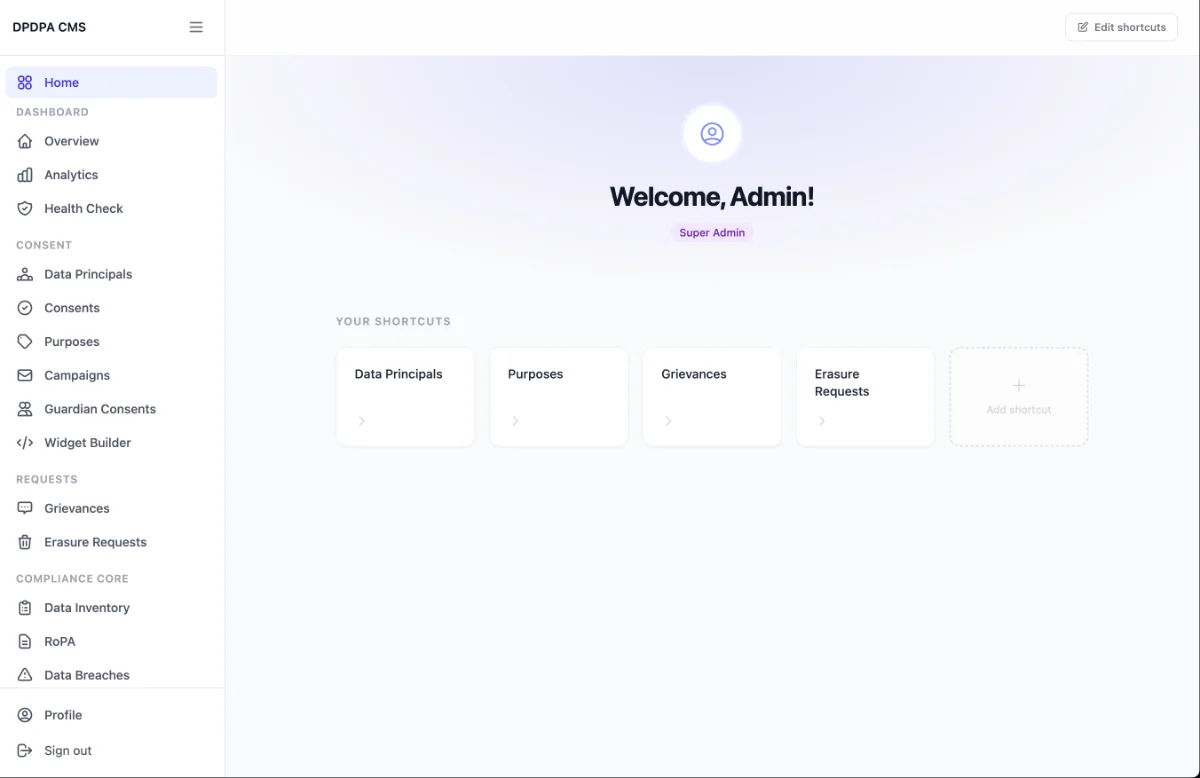
How DPDPA CMS covers each one
Why self-hosted, at any size
The more personal data you hold, the more it pays to keep it in-house.
No new third party
Personal data and consent records stay in your environment. Nothing new for your sub-processor list or your cross-border assessment.
Your security, not ours
It runs under the identity, network, logging, backup and audit controls you already operate.
A cost that doesn’t grow with you
Subscription tools charge by users, data principals or visitors. DPDPA CMS is a one-time setup fee, then support.
A shorter vendor review
We never host, see or process your data.
Built to replace legacy tools
- Expensive annual licences
- Vendor-hosted: your data leaves your walls
- Heavy, slow to roll out
- One-time setup, support fees only
- Self-hosted: data stays in your environment
- Purpose-built for DPDPA, quick to deploy
We're building to replace expensive tools like OneTrust.
See how DPDPA CMS compares with OneTrust, TrustArc, Privy, Consentin and GoTrust →
Verify Before Trust.
Use DPDPA CMS in your own environment for 3 months. No charge, no commitment. Pay only if you see value.
Questions buyers ask
What is DPDPA CMS?
Self-hosted software for India's Digital Personal Data Protection Act. It covers consent and re-consent, rights requests, data inventory and RoPA, sub-processors, privacy impact assessments, controls and audit logs, all running in your own environment.
Is DPDPA CMS a SaaS product?
No. It runs on your servers or your private cloud, in India or wherever you choose. We never host, see or process your data.
How is DPDPA CMS priced?
A one-time setup fee, then support fees. There is no recurring licence.
Can we try it before buying?
Yes. Use DPDPA CMS in your own environment for three months, with no charge and no commitment, and pay only if you see value.
When do we need to be DPDPA compliant?
Data Fiduciary obligations and the penalty provisions commence on 13 May 2027. Consent Manager registration is mandatory from 13 November 2026.
Is a self-hosted tool right for a large enterprise?
Yes. A large organisation holds the most personal data, so keeping it in-house removes the most exposure, and a one-time fee avoids subscription pricing that grows with its size.
More: DPDPA deadlines · Which rules apply to you · DPDPA vs GDPR · Compare alternatives · DPDPA consent tools compared · DPDPA vs RBI, SEBI and CERT-In